

Many believe they have addressed AI sovereignty because they know where their model is running. Perhaps they use a private model, deployed in a sovereign cloud, or keep inferences within a particular region.
That is a start. But it does not make their AI sovereign.
AI sovereignty is the ability to control the entire system behind an AI outcome: the data, context, models, infrastructure, workloads, policies, decisions, and actions. If you control the model but not the data that feeds it, you control only one component of a much larger and potentially much riskier system.
The most important sovereignty question may be one that many organizations don’t tend to ask: Can we control the data our AI depends on?
AI Sovereignty Is an Enterprise Risk
AI sovereignty is often framed as an issue for governments: national security, domestic infrastructure, strategic independence, and protection from foreign influence.
But every organization using AI has a sovereignty problem.
An enterprise may depend on models operated by an external provider, infrastructure and application logic controlled by a SaaS provider, data assembled in a lakehouse, context retrieved from vector databases, and business information drawn from hundreds of operational and SaaS systems. Each dependency introduces questions of control:
- Where does the data reside, and where is it processed?
- When is it copied, cached, embedded, or included in logs?
- Which laws and policies apply in each location?
- Who can access it, and can policies be enforced when AI retrieves it?
- Can the organization change models, platforms, or providers without rebuilding everything?
- Can it explain which data and business context led to an AI decision or action?
These are not merely technical questions. They concern regulatory exposure, intellectual property, business continuity, vendor leverage, and executive accountability.
If your AI depends on data you cannot locate, policies you cannot consistently enforce, or infrastructure you cannot easily exit from, then your AI is not sovereign; it is dependent by default.
The AI Stack Extends All the Way Down to the Data
Traditional data-sovereignty programs focused primarily on where databases, files, and applications were physically located. AI makes the problem more complicated.
Data may now be inserted into prompts, converted into vectors, copied into retrieval systems, transmitted to model APIs, retained in logs, or exposed to autonomous agents. At inference time, an agent may retrieve business data, interpret it, make a decision, call a tool, and update a system of record.
Every step can create a new sovereignty boundary.
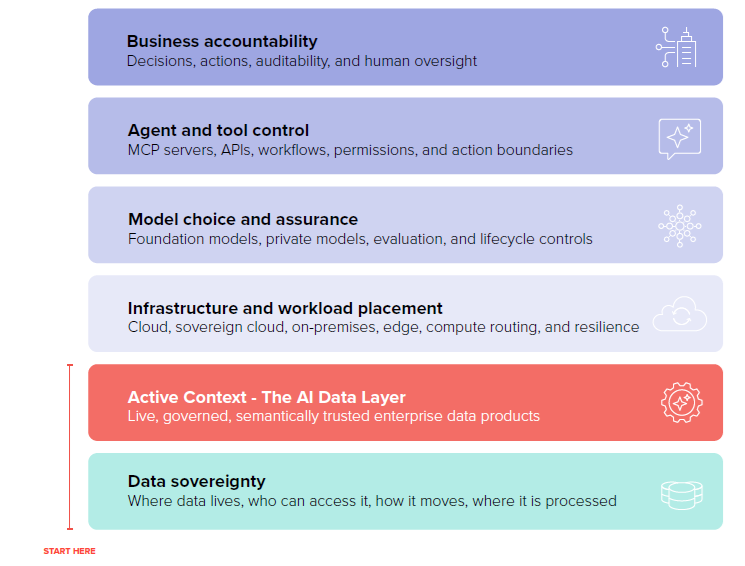
This is why running a model in an approved environment is not enough. Sovereignty controls must extend throughout the AI stack, and particularly into the data and context layer, where AI systems obtain facts, apply business meaning, and determine what information they are permitted to use.
The Enterprise AI Stack:
Centralizing Data Can Reduce Control
Many enterprise data architectures are based on moving data into a centralized platform such as a data lakehouse. Centralization can serve valuable analytical purposes, but it can also complicate sovereignty.
This may seem counterintuitive, until you think about it: Every data movement to the lakehouse raises questions. Is the data leaving an approved region or sovereign environment? Is the lakehouse destination fully under the organization’s control? How will this additional copy be secured, governed, monitored, and eventually deleted? Is the organization becoming more dependent on the destination platform’s proprietary services, storage, and processing? How easy is it to migrate away from that platform, if needed?
The answer is not that data should never move. It is that data should move only when the organization deliberately decides that movement is necessary for the use case, and not because it is a default requirement of one’s chosen data platform.
Sovereignty should mean having the freedom to decide where data remains, where processing occurs, and when copying is justified. An architecture that requires every dataset to be moved into one platform before it can be governed or used by AI limits that freedom.
An AI Data Layer Changes the Equation
An AI data layer, which sits between an organization’s data sources and their AI systems, provides a different approach. Rather than centralizing all underlying data, it creates a common virtual control layer across distributed cloud, on-premises, SaaS, lakehouse, warehouse, and operational environments.
The Denodo Platform delivers this layer by connecting AI consumers to governed, logical data products rather than directly to physical sources. It provides active context: the consistent business semantics, lineage, security policies, and live data access across the distributed estate, without requiring data to be copied merely to bring it under control.
This gives organizations greater agency over:
- Where data is maintained
- Where processing and workloads occur
- Which users and AI agents can access which information
- Which business definitions and authoritative sources AI should use
- When data should be accessed live and when it should be copied
- How underlying infrastructure can change without disrupting AI consumers
The objective is not maximum centralization, it is deliberate control.
Portability Is the Ultimate Test of Sovereignty
Regulatory frameworks around the world increasingly extend control requirements across the AI lifecycle. They address not only responsible model behavior, but also data residency, access, processing, transfers, auditability, infrastructure choice, and portability.
Portability is especially important. An organization must be able to move data and workloads away from an environment it no longer trusts — or one that no longer meets its business needs.
But theoretical permission to switch providers is not enough. If moving data requires every AI application, agent, dashboard, API, and data pipeline to be rebuilt, lock-in remains very real.
An AI data layer decouples workloads from the physical location of data. The organization can repatriate selected agents and apps, move between clouds, adopt sovereign infrastructure, or change lakehouse platforms, all while preserving a consistent layer of access, semantics, and governance for the consumers above it.
That is what meaningful portability looks like: not simply the ability to move, but the ability to move without disrupting the business.
How Sovereign Is Your AI?
The first wave of enterprise AI focused on access to models. The next will focus on control: control of data, context, policies, workload placement, infrastructure choices, and agent actions.
Organizations that establish that control will be able to innovate with greater confidence, respond more quickly to regulatory and geopolitical change, and negotiate technology decisions from a position of strength.
Those that do not may discover that their AI strategy rests on data they cannot fully govern, platforms they cannot easily leave, and dependencies they did not realize they were creating. In short: If you cannot control the data behind your AI, you cannot truly control your AI.
Next Steps
Take our online self-assessment, “How Sovereign Is Your AI and the Data It Depends On?” to identify where your organization has meaningful control and where hidden dependencies may be putting your AI strategy at risk.
See our whitepaper, “AI Sovereignty Starts with Data Sovereignty,” for a deeper discussion on this topic.

- AI Sovereignty Starts with Data Sovereignty - August 24, 2026
- Data Orchestration: The Critical Foundation for Enterprise AI - July 30, 2026
- Stop Paying LLMs to Do the Data Layer’s Job - July 27, 2026