


All technologies go through a hype cycle — and the data Lakehouse is no exception. After years of aggressive migration push by vendors, many organizations are experiencing Lakehouse Fatigue. They’ve moved data, paid the migration bill, and are still waiting for the promised return.
The core problem is not the Lakehouse architecture — it is treating the Lakehouse as the destination rather than the foundation. Storage without delivery is infrastructure without impact. To extract real business value, organizations need a layer that can be used to query across multiple data formats and sources, bridge the gap between analytical and operational systems, and surface trusted data products to the teams and systems that need them. That is precisely the gap Denodo is designed to close.
A Unified Data Delivery Layer: Across Every Format and Engine
The whole premise of an open data Lakehouse is flexibility: the freedom to choose the query engine and table format that best fits each workload. But that flexibility only has value if you can actually move between options without rebuilding your data pipelines every time.
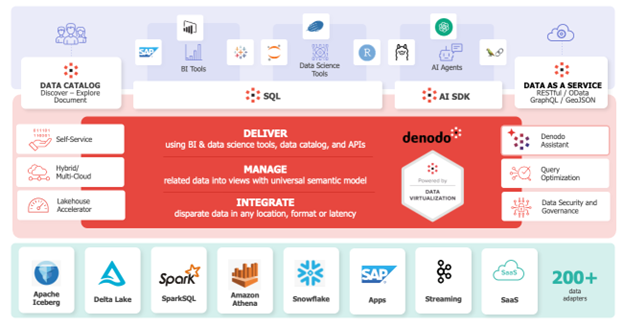
Denodo can act as the unifying delivery layer that sits above your Lakehouse, supporting multiple query engines and open table formats simultaneously — including query engines such as SparkSQL and Amazon Athena, and table formats such as Apache Iceberg and Delta Lake. Denodo offers extensive integration support for all parts of the Lakehouse ecosystem, regardless of whether your data resides in AWS S3 with a Hive Metastore or Unity Catalog. Denodo delivers a single semantic layer that abstracts the physical complexity from data consumers.
This means your analysts, data scientists, and AI application developers can leverage consistent, governed data products — regardless of what format the data was stored in or which engine is needed to process it.
Denodo Lakehouse Accelerator: Next Generation Query Performance
To improve query performance for customers wanting direct access to Lakehouse files without a third-party query engine, Denodo recently re-launched version 2.0 of the Denodo Lakehouse Accelerator (previously known as the “Embedded MPP”). The rebranding underscores Denodo’s commitment to the Lakehouse architecture as well as our focus on query acceleration and performance.
But the relaunch goes beyond just a re-naming exercise. Denodo Lakehouse Accelerator 2.0 represents a significant architectural evolution — moving beyond its origins as an embedded MPP engine to become a fully integrated high-performance Lakehouse query engine powered by the new Velox (Presto 2.0) technology.
Denodo Lakehouse Accelerator speeds up analytics and data delivery across open-standard-based data Lakehouse and can now leverage its MPP (massively parallel processing) engine in more powerful ways. By building deep and sophisticated integration between the Denodo Lakehouse Accelerator and the powerful Denodo Platform query optimizer, customers can expect significant query performance improvements across single source (Lakehouse only) and hybrid, multi-source scenarios (Lakehouse and other data sources).
In internal benchmark testing, Denodo Lakehouse Accelerator 2.0 demonstrated query performance improvements of up to 4x compared to the previous Presto-based engine. The improvement is a significant step forward in query performance — one that directly reduces time-to-insight for both single-source and multi-source workloads.
Data Products, Not Just Data Storage
The Lakehouse architecture discussion so far has been too focused on where and how data is stored — Iceberg or Delta, S3 or OneLake. The more important question is how quickly and reliably that data reaches the people and systems that need it.
Denodo enables a product-based approach to data delivery. Rather than exposing raw table files or complex query interfaces and pipelines, Denodo allows data teams to easily define, publish, and govern data products with a low-code/no-code approach. The result is that non-technical users can easily build reusable, trusted data assets with clear ownership, documented semantics, and enforced access controls.
This shift from project-based to product-based thinking is how leading organizations are accelerating time-to-value from their Lakehouse investments. It is also how they are enabling true self-service analytics: business users can discover and use data products without needing to understand the underlying physical architecture.
The Lakehouse Is the Foundation. Denodo Is the Accelerant.
The data Lakehouse represents a genuine architectural advancement. Open formats, decoupled storage and compute, and support for diverse workloads are meaningful capabilities that have simplified enterprise data architecture in important ways.
The organizations that will lead in the next phase of data-driven decision making and Agentic-driven automation will not necessarily be those with the largest Lakehouse. They will be those who built the most effective delivery capability on top of it — turning stored data into governed, accessible, and actionable data products at the speed the business demands. The missing delivery layer is the difference. Denodo closes that gap.
If your Lakehouse investment has yet to deliver at the speed your business demands, we’d welcome the conversation.

- Closing the Lakehouse Gap: From Data Storage to Data Delivery - March 26, 2026
- Build AI-Ready Data Products with Denodo - October 16, 2025
- From Chatbots to Agents: Navigating the Future of AI - July 3, 2025