

By 2027, half of all business decisions will be made or augmented by AI agents. That’s not a sci-fi projection—it’s a Gartner prediction. But if you’ve ever asked ChatGPT a “why” question about your business, you already know the gap between aspiration and reality. Large language models (LLMs) can write sonnets or summarize PDFs, but when it comes to complex, multi-step decisions powered by live enterprise data—most fall flat.
The real bottleneck? AI agents don’t just need intelligence. They need data – the right data, in the right context, under the right governance.
This is where Denodo comes in. While others focus on building bigger models or specialized copilots, Denodo is tackling the hard but necessary foundation: enabling AI agents to reason, plan, and act on enterprise-grade data without being tripped up by silos, delays, or compliance risks.
From Chatbots to Agents: The Rise of Autonomous Decision Intelligence
Before diving deeper, I’d like to quickly clarify what I mean by “AI agents” and “agentic AI.”
AI agents are autonomous software systems that can make decisions, take action, and interact with data or environments based on goals given by users. Unlike simple chatbots or scripted automations, these agents operate independently, often over extended periods, and can plan, reason, and adapt in real time.
Agentic AI refers to the broader class of intelligent systems capable of breaking down complex tasks, selecting the appropriate tools, navigating uncertainty, and executing plans across multiple steps—often with minimal human intervention. These systems require a robust foundation of context-rich, governed, and accessible data to operate effectively—which Denodo delivers.
It’s easy to get an AI model to summarize a document. But ask it to analyze a decade of tourism data and recommend how to improve high-value visitor segments, and you’ll quickly find yourself hitting limitations. These types of questions require not only language understanding but deep reasoning, data access, and contextual awareness.
Denodo is delivering a new kind of assistant that doesn’t just respond with text but understands complex questions, builds a plan to answer them, queries real-time data from multiple sources, applies business logic, and presents conclusions that are not only accurate but explainable.
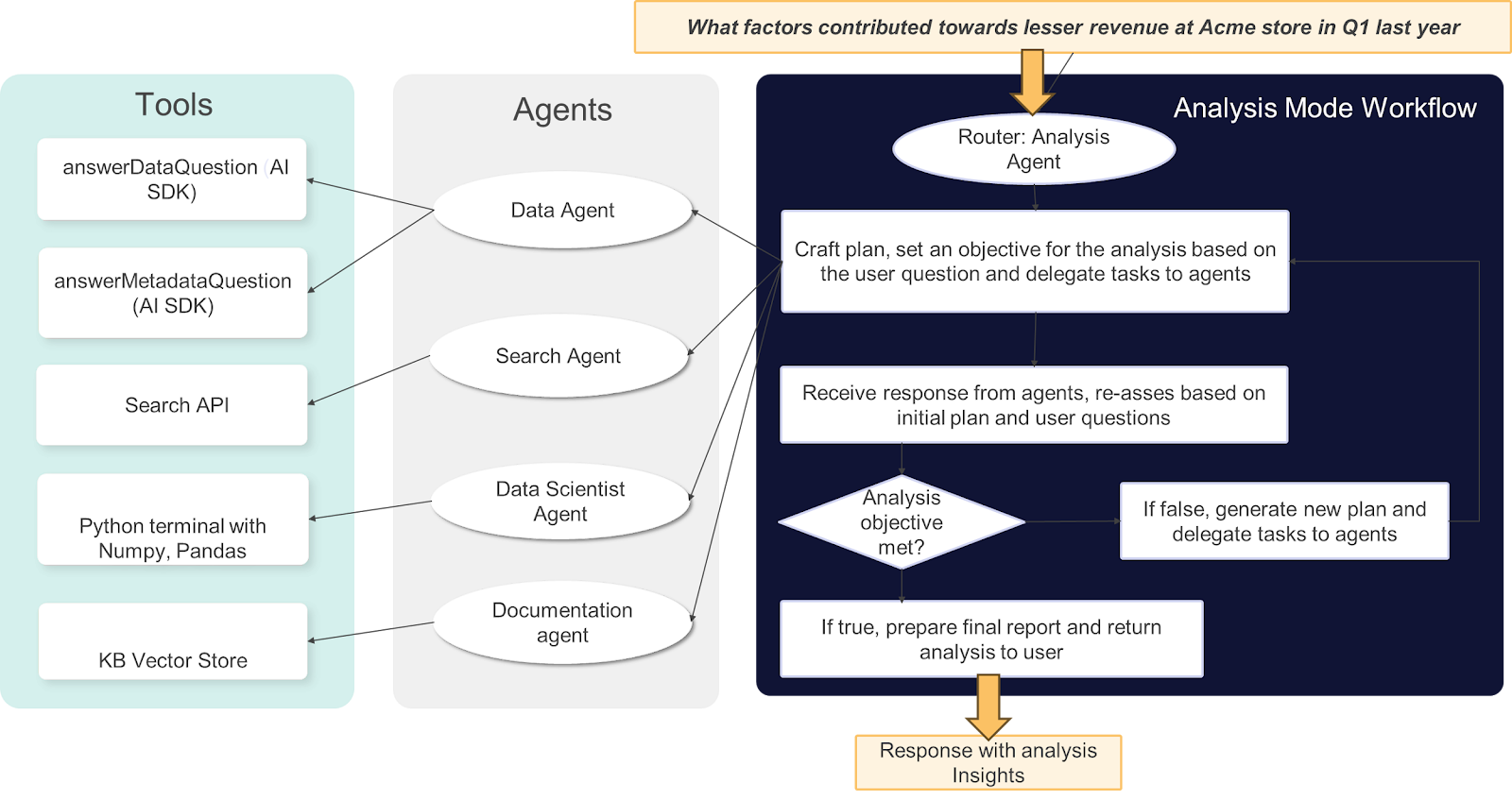
Denodo DeepQuery, currently available as a privatepreview, is a purpose-built AI agent that handles complex, multi-step analytical tasks. It breaks down a user’s question into multiple logical steps, crafts an execution plan, and intelligently routes sub-tasks to the appropriate data services or micro-agents. DeepQuery maintains contextual memory throughout the process, enabling dynamic reassessment and synthesis of partial results until the final answer meets the user’s goal. It follows a planner-executor architecture, similar to what’s being adopted across the industry, dynamically selecting tools and adjusting strategy based on intermediate outcomes.
At the core lies the Denodo Platform’s semantic layer—a business-friendly abstraction layer that provides definitions, relationships, and metadata context. Instead of treating data as mere tables and fields, the semantic layer helps the agent understand what a “high-value guest” or “Q2 revenue” actually means in business terms. This layer functions like a data registry for agents, giving them a single catalog to resolve meaning, location, and usage policies.
This is powered by the open, extensible Denodo AI SDK, which provides the development tools and APIs to rapidly build, test, and deploy AI-powered agents across hybrid data environments. It includes modules for orchestrating multi-agent workflows, integrating semantic metadata into LLM prompts, and invoking DeepQuery capabilities programmatically. The SDK simplifies integration with vector databases, orchestration tools, and language models of your choice—whether that’s OpenAI’s ChatGPT, DeepSeek’s R1, or others. The Denodo Platform’s model-agnostic and future-proof architecture provides flexibility without lock-in.
Putting AI to Work: Real-World Stories
Organizations across industries are already investing in agentic foundations with Denodo.
Festo significantly improved GenAI reliability and speed-to-delivery by using Denodo’s logical data fabric and AI SDK. By unifying access to distributed data sources and applying semantic metadata for retrieval-augmented generation (RAG), Festo reduced hallucinations, accelerated development of GenAI use cases, and enabled secure, role-based access to enterprise data. They developed the FestoGPT application, similar to ChatGPT, enabling consultants and other customer-facing staff to ask questions of an LLM. Additionally, the Festo Skillground application was introduced, offering colleagues a variety of AI tools, such as text-to-speech and image generation, aimed at simplifying and streamlining tasks.
At Perkins Coie LLP, legal and client service professionals now benefit from a custom AI-powered chatbot using a private LLM, integrated with the Denodo AI SDK. Known as PC Chat, this solution enabled employees to ask legal and financial questions in plain English and receive tailored responses instantly. As a result, client response times significantly improved.
To modernize its data landscape and support GenAI-driven services, Alexforbes implemented the Denodo Platform and AI SDK. This unified access to fragmented systems, improved Power BI integration, and enabled secure, real-time insights through natural language queries. A custom Power BI widget and metadata-driven indexing made data accessible across roles and geographies, improving financial calculations, operational efficiency, and the overall member experience.
The Denodo Advantage in the Modern AI Stack
Today’s popular data platforms—such as data lakehouses— bring strengths like massive scale, fast compute, and specialized formats. However, most still require additional layers to serve AI agents effectively. Denodo complements these environments by adding real-time integration, semantic context, and governance without data duplication.
Denodo enables agents to query structured, semi-structured, and file-based data sources—across SQL systems, file stores, APIs, and streaming data—while consistently applying security and access policies. This hybrid data orchestration capability gives AI agents a live, governed foundation to work from.
Instead of migrating data or rebuilding logic for each use case, enterprises can use the Denodo Platform to provide a consistent, governed interface across systems. This enables agents to operate on a live, comprehensive view of the business—essential for decision intelligence.
If you’re building copilots or intelligent agents, the real question isn’t which model to use—it’s whether your data foundation is ready. With Denodo, it is.